The page you're on takes about 11 minutes to read.
4chan was actually one of the most performative places I’d ever visited online!
In the late 2000s, the media portrayed 4chan primarily with lies and panic. Almost all coverage implied that 4chan held terrible, unmentionable horrors that one could never possibly find on the normal internet. Drugs? Maybe? Child sexual abuse material? Supposedly this was all on 4chan, right? There was also a strange implication that the site was somehow harder to access or find than the normal internet, something unexplained to this day.
So much coverage of 4chan played up the notion that it lacked moderation of the typical mid-2000s sort. Few of these segments showed more than a tacit glance a the boards themselves, naturally. It would’ve been really dull to show a screen scrolling the usual porn-laden (but otherwise tame) site, after all.
Some segments even equated 4chan with the fabled deepweb. Hey, wait a minute, though? What’s the deepweb? Really nebulous term that could really refer to anything. Nowadays, and if used usefully, the word refers to sites accessible via Tor or other nonstandard ways, yes. Many of these do contain the kind of material that was supposedly on 4chan (but wasn’t). Some of these actual deepweb sites were or are no doubt chan-styled, but it’s hard to say.
In reality, 4chan wasn't like that. Don’t think you can babble about being on the deepweb because you browsed /b/ at the right time, in other words.
The media lied about the whole thing, though? And continued to lie? 4chan was never a zero moderation free-for-all. If anything, 4chan is, and has always been, one of the most moderated of the so-called chan websites out there. I also visited other chan sites. These included one called 420chan. It specialized in the content you’d expect from the title, and was much less moderated than 4chan. Even 420chan, though, was fairly strict and did not encourage the brazenly illegal.
You wouldn’t find illegal content on 4chan, even back then, of course. Very, very very sporadically, you might run across someone pretending to sell (or actually selling) drugs or hardcore porn, or something of the sort. This got filtered quickly. Rumors of such things circulated far more than anything of the sort itself. Heck, if I remember right, you could not even post links to 420chan (the other site) because of the titles?! Moderation on 4chan was real and heavy, actually.
4chan, even early on, had a massive army of janitors working to keep things from going wrong. Janitors got called “jannies” in the parlance of most boards and were generally derided. There was some kind of joke about how they (I think) didn’t get paid to do it, and thus must have other motivations.
People did worry about that. Ultimately, they felt like any other forum moderator doing it for free, though. I knew a couple over the years. Miserable human beings, really. It was, apparently, a thankless job. It was also the kind of thing they mostly kept their mouth shut about doing, too. Either way, the system worked, and well.
Despite this, the media found plenty of material to spin into wild tales. Let’s not forget those 4chan raids, horrible instances of the site spilling into the regular world, right? The media did occasionally love those yarns. The most famous (for many reasons) of these would be the below broadcast from Faux News.
Even back then, nobody took Faux seriously. This message got echoed elsewhere, though. Was 4chan really a sinister cabal of antisemite racist hackers? A lot of media narratives from the 2000s wanted it to be so, because it gave them something to write about
Let’s not mince words, though. It’s not as if this was Penny Arcade, though. Even with its early moderation, 4chan was unusual on the Anglophone internet, with its tripcode system and “post almost anything” attitude. I just spent quite some time explaining that yes, 4chan was moderated. That said…
It was certainly far less moderated than most online spaces. I think that, combined with sheer concepts like anonymity on that level, etc, broke some media narratives really hard. A lot of media didn’t know how to explain 4chan or the culture surrounding it? This is how we ended up with claims of HACKERS ON STEROIDS. I can’t explain it well otherwise, because frankly, those news reports were dumb.
It would’ve been one thing if the media just told a bunch of lies about 4chan being edgy. That wasn’t what happened, though. The users cultivated their own panache which was (also) a total fabrication. C’mon! If the media thinks we’re scary, let’s keep this going, right?! Etc.
Let’s not mince words. This played very very very well into the burgeoning “ironic racism” movement. By the late 2000s, racism had morphed into this strange game for a lot of people. For some (most) people spouting off, their bigotry was genuine. Yet, irony became a shield against criticism. Please write that part down, or memorize it, because it’s important.
If you complained about the guy spamming slurs in the chat, you weren’t just too sensitive, you also didn’t get the joke, because clearly it was ironic, right? A lot of these people ended up involved in the burgeoning American neoreactionary movement. On Reddit especially, this would evolve into support for things like Donald Trump. More on this later, and throughout this article, of course. It’s a running leitmotif in channer discourse over the past decade and a half, and I can’t ignore it.
Half of the raids and notorious activities that 4chan got blamed for? Never happened, or were insignificantly small, designed to look much larger by the 4channers. This became a regular pattern for the site’s shenanigans, repeating over and over in different scenarios. Often, the goal was setting up a situation that looked worse than it could be. Can we make the rest of the Internet think that something stupid and unusual is going on? That was the game in and of itself!
Usually, the answer to that question was a loud no, though. 4chan didn’t succeed a lot of the time. People (at the time) did not fall for things like the Tumblr vs. 4chan battle. Nobody really bought into “Bald for Bieber.” I am skeptical that anyone leaked their own nudes in solidarity with Jennifer Lawrence. All of these were, allegedly, 4chan operations.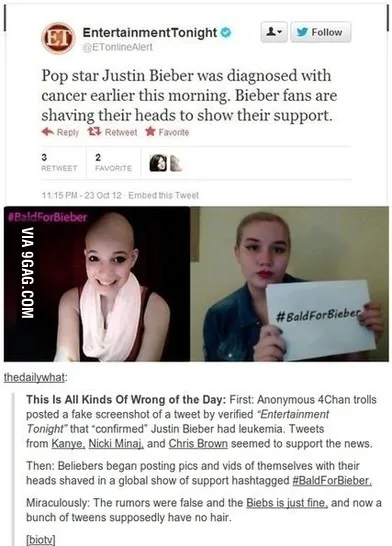
4chan itself (well, let’s be honest, mostly /b/ and the like) tried very hard to make these things appear real. Yet, outside of the utterly tone-deaf, nobody took them seriously. People chuckled, but they were laughing at 4chan, not with 4chan. The people 4chan ostensibly attacked through these operations didn’t really care. Usually.
Don’t mistake me. There were noticeable exceptions to this. In some instances, you had the site itself (yes, often entire boards) attacking just one person, someone without metaphorical bouncers like Jennifer Lawrence. This was Rebecca Black or some other YouTuber, fanfic writer, or whoever. That did happen. Often, the targets were incredibly young in these instances, too.
Usually, it moved off-site quickly, and dissociated itself with 4chan, soon. Unlike some smaller chan-style sites, 4chan itself has never hosted an /i/ (invasion, in other words) board. I remember Moot (4chan’s creator) being asked in an open offline venue to create one. He called the impetus “the cancer killing /b/“ at that point, aloud. The janitors and moderators and such didn’t exactly encourage using the site to organize harassment campaigns. In other words, claims about 4chan as a nexus of bullying were also overplayed. It might start on 4chan. Ultimately, though, other sites tended to fill the niche rather than 4chan itself.
Exceptions tended to be those huge and extremely noticeable events that made the news for weeks. These were those precious few large, meaningful, and truly ideologically-motivated 4chan operations. These included Chanology, Gamergate, and the support on 4chan and Tumblr for Julian Assange, as examples. These are exceptions, thought. They’re significant because they differ from the usual noise of 4chan trolling operations. Most of the 4chan-level aspects of those operations amounted to tamer things compared to what went on elsewhere, too.
Your average 4chan raid would feature 4chan, or maybe a couple unmentionables, too. In these instances I mentioned, the large ones, 4chan itself managed to expand their wars beyond their borders without losing steam. Chanology in particular roped in half the internet. I wrote a bit about it, and my involvement with it, already. I had been on 4chan for years at that point. Other people heard about it through Chanology, increasing numbers. Even without that, people from other sites participated in 4chan’s “raids” on the Church of Scientology just because it was (admittedly, and don’t lie) hilarious.
Gamergate was practically the World Wide Web’s Civil War. I suggest you catch up on it and what happened, because I suppose it’s culturally relevant online. Like most sudden and intense civil wars, it started with some ridiculous nonsense that should’ve stayed private out of everyone’s face. My occult obsession at the time meant I didn’t get too close to Gamergate, and probably missed some nuances. I remember noticing some people from my usual IRC channel were also in one called #burgersandfries.
I figured out that it had something to do with Zoe Quinn. Someone sent me an angry message on another server about it, too. They weren’t angry with me, though. It was just expressing that they were now unable to tell if games were “turn-based” because of it? It was very odd. Anyways, I remember some weird hyperfixation amongst the occultists on Zoe Quinn’s tech. She allegedly has an implant beneath her skin allowing her to log onto things quicker or something. For some reason, this freaked me out slightly at the time. 2015. What even. I didn’t see it as bad, just a shock to hear. Adapt to a world where it’s there, etc.
The Julian Assange support involved awful shipping fanfiction on Tumblr and horrible content elsewhere, too. Okay, maybe the latter’s a bit silly. It nevertheless coincided with widespread support for Assange. I mention it not because it was a huge 4chan operation, but because it was one example where 4chan went wild with activism, and then other sites joined in. These other sites, like Tumblr, quickly brought their own culture. It was a strange mixture.
I remember the 4channers making songs on YouTube about those “awful yanks hunger and thirst” for Assange’s blood. Meanwhile, Tumblr users wrote self-shipping fanfic about dating Julian Assange as part of a website called the “Julian Assange Fanciers Guild.” It was very bizarre. I get that the man was not poorly-designed, yes, but there was no reason to sexualize him that much. He was accused of rape, too.
I personally think most of the super-successful 4chan “raids” would’ve happened without 4chan at all. In all these cases, 4chan was riding an existing zeitgeist of sorts, bringing together other sites, too. There also weren’t many of these cases to begin with, not compared to the many ridiculous attempts made…
Here, I could talk about Qanon, a political conspiracy theory movement taking place (largely) on 8chan. It served to support Donald Trump, and to spread the idea that his enemies were a secret evil cabal about to meet justice. It’s hard to say how the Qanon ruse began, but I (and most people) tend to believe Ron and Jim Watkins took over as Mr. Q to drum up visitors for their chan site, 8chan. Stupid fake wannabe Light Yagami.
4chan clearly influenced culture in a huge way, though. A lot of this is because of the aforementioned large, exceptional events in some ways. Mostly, though, 4chan’s influence has been subtle yet incredibly pervasive. There are memes and turns of phrase even online that you likely use, dating back to 4chan. Caturday will never die. Greentexting goes anywhere, and honestly I still do it in some venues myself. Images like (much of, admittedly) Trump’s himself in 2016 were created by these sites. Nobody even tangentially involved in gaming during the early 2010s will forget Gamergate. Sadly, Qanon has inspired a lot of real world nastiness. So yes, the site wields influential.
The influence is there, but not in the way 4chan wanted it to be, pretended it was, and acted like it was at the time. I’d argue that alone was part of why the influence kept going, too. But why the lack of authenticity in an anonymous place? Gee, I don’t know? Maybe just posting anonymously doesn’t create a space for expressing the true self (or whatever) after all. Perhaps that was never the point, but it’s a bit of a disappointment culturally, even if some aspects have a nostalgic haze…
This page was last updated on January 21st, 2026.